The Atmospheric Imaging Assembly (AIA) provides multiple simultaneous high-resolution full-disk images of the corona and transition region. SDO/AIA allows us to image the solar plasmas with the temperature range of 0.05-2 MK. The composite image «211 + 193 + 171» consists of three images taken at three different wavelengths centered at 211, 193 and 171Å. For composite images, the wavelengths are listed in order of the red, green, and blue display channels. Each image shows the date and time it was taken; image composites show three date-time sets, color-coded by the associated display channel.
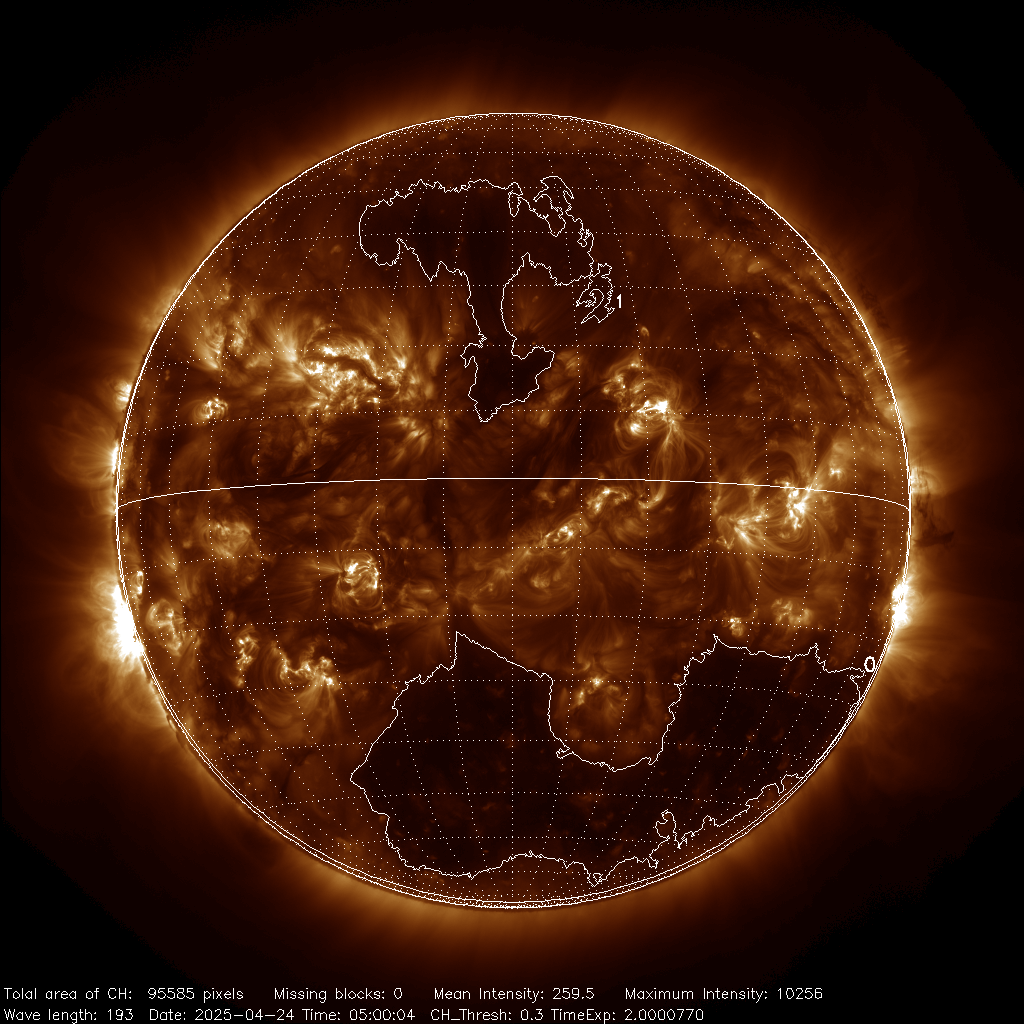
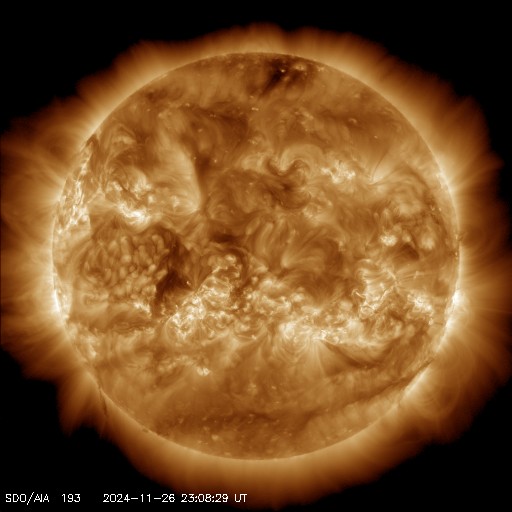
The image obtained from SDO/AIA at wavelengths centered at 193Å. The 193 Å channel is dominated by ions Fe XII (T~1.6 MK ) and ions Fe XXIV (T~20MK). This bandpass is optimized to study outer solar atmosphere (corona): hot active regions, solar flare, coronal holes
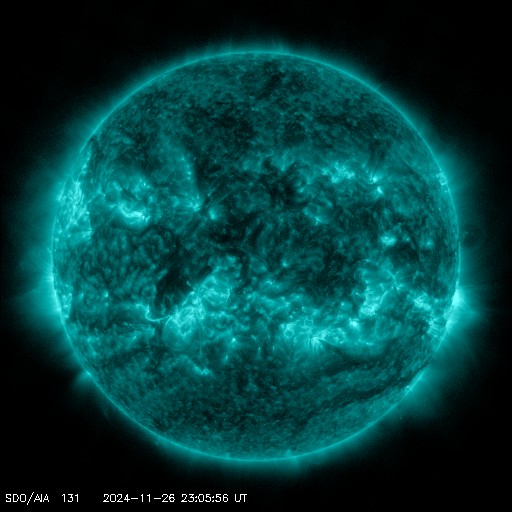
The image obtained from SDO/AIA at wavelengths centered at 131Å. The 131Å cannel includes several emission lines and its predicted temperature sensitivity is bimodal. The cooler peak (Fe VIII emission) is centered near ~ 0.4 MK. The hotter peak is centered near 10 МК is composed of Fe XXI line. This cannel is optimized to study solar flare.
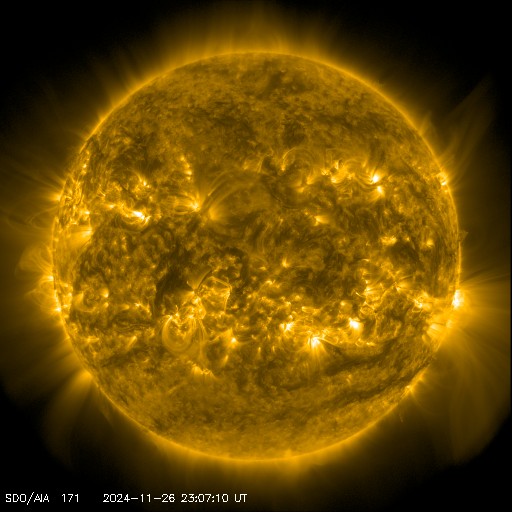
The image obtained from SDO/AIA at wavelengths centered at 171Å. The 171Å cannel is centered over a blend of Fe IX and Fe X emission which is strongest at a temperature of 1 MK. This cannel is good to study upper transition region, quiet corona and coronal loops (magnetic arcs).
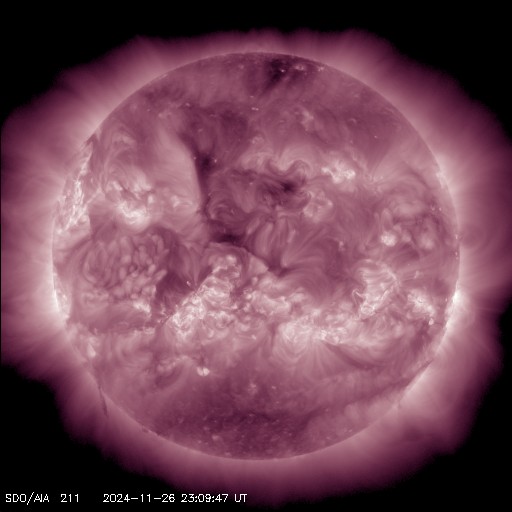
The 211Å cannel is centered on a Fe XIV transition at 211.3Å. In terms of ionization equilibrium, FeXIV reaches a peak ionization at 2 MK. This cannel is optimized to study solar corona.
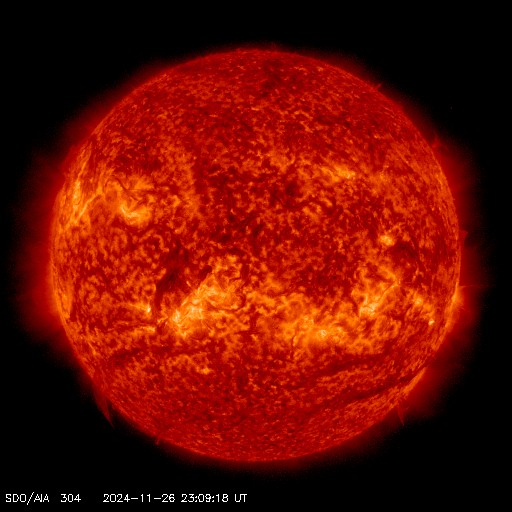
The image obtained from SDO/AIA at wavelengths centered at 304Å. The 304Å channel is dominated by the ions He II (T ~ 0.05-1 МК). This temperature range corresponds to the plasma of chromosphere and transition region
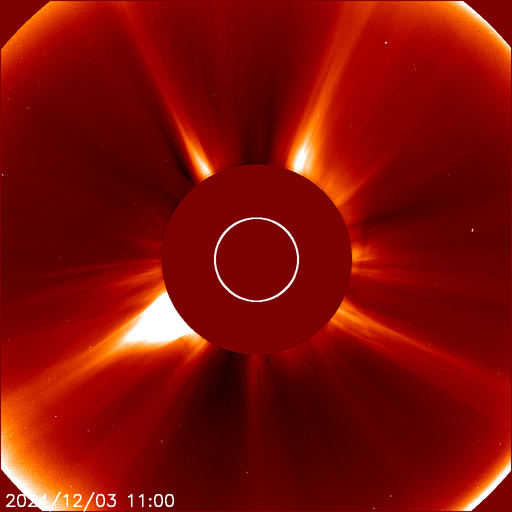
The Large Angle and Spectrometric Coronagraph (LASCO) instrument is one of 11 instruments included on the joint NASA/ESA SOHO (Solar and Heliospheric Observatory) spacecraft. The LASCO instrument is a set of three coronagraphs that image the solar corona from 1.1 to 32 solar radii. It is convenient to measure distances in terms of solar radii. One solar radius is about 700,000 km, 420,000 miles or 16 arc minutes. A coronagraph is a telescope that is designed to block light coming from the solar disk, in order to see the extremely faint emission from the region around the sun, called the corona.
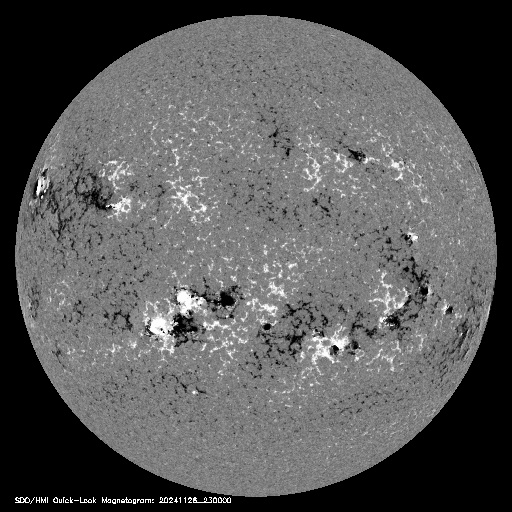
It is well known that there is a remarkable connection between the passage of the low latitude coronal holes (CH) across the solar disk and the recurrent high-speed solar wind streams recorded in Earth orbit. The CHs are normally identified as regions of unipolar magnetic field, which appear as regions of decreased intensity in the ultraviolet and X-ray solar images owing to low plasma density. In order to forecast the solar wind streams, we used the values of the relative areas of the CHs which are calculated by normalizing the absolute areas to the size of the solar disk without a limb. Algorithm of CH parameters calculation is based on the classification of image points according to threshold intensity.